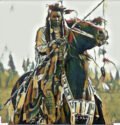
The Languages of the Plateau
The Columbia Plateau was a linguistic crossroads. Because the region was home to several distinct language families, tribes often lived in close proximity but could not understand one another’s native tongues. This diversity was a major factor during treaty councils, where ideas had to be translated across multiple linguistic barriers.
The Major Language Families
- Sahaptian: Spoken primarily in the southern Plateau (Washington, Oregon, Idaho). This family includes the Nez Perce, the Umatilla and Walla Walla, and the 14 bands of the Yakama Nation.
- Interior Salish: Dominant in the northern Plateau, reaching from British Columbia into Montana. This group includes the Spokane, Coeur d’Alene, Kalispel, Okanagan, and the Colville confederated bands.
- Chinookan: Historically spoken along the Middle and Lower Columbia River, including the Wasco and Wishram (Kiksht language).
- Language Isolate (Kutenai): The Kootenai people speak a unique language that is entirely unrelated to any other known language family in the world.
Chinook Jargon: The Language of Trade
Because of this immense diversity, a “bridge language” or pidgin known as Chinook Jargon emerged. It was not the native tongue of any one tribe but a hybrid of Chinookan, Nuu-chah-nulth, French, and English.
- The Great Unifier: At its peak in the late 19th century, over 100,000 people—including traders, pioneers, and members of dozens of different tribes—used Chinook Jargon to conduct business.
- Legacy: While the jargon declined as English became dominant, it survives today in regional slang like skookum (strong/good) and cheechako (newcomer), as well as in countless Northwest place names.
Note on the Treaty Era: During the 1855 councils, Governor Isaac Stevens often spoke in English, which was translated into Chinook Jargon, and then translated again into various tribal Sahaptian or Salish dialects. This “triple translation” often led to critical misunderstandings regarding land boundaries and legal rights.
Clashing Worldviews: The Invisible Front Line
The conflict in the Pacific Northwest was not merely a battle over borders; it was a collision between two incompatible ways of existing in the world. To understand the violence of the 1850s, one must first understand the fundamental differences in how each side viewed the earth, the divine, and the future.
1. The Concept of Land and Sovereignty
- The Indigenous View: Land was a sacred, shared resource—the literal source of life. Tribes held traditional “usufruct” rights (the right to use and steward specific territories for hunting, fishing, and gathering), but the idea of an individual “owning” a piece of the earth was alien. In this worldview, the people belonged to the land as much as the land belonged to them.
- The Settler View: Driven by the ideology of Manifest Destiny, settlers viewed land as the primary measure of wealth and freedom. Their legal and economic systems were built on the “parcel”—the division of the wilderness into private lots to be claimed, “tamed,” and “improved” through agriculture and industry.
- The Strategic Conflict: When treaty negotiators used terms like “cede” or “sell,” settlers believed the land was being permanently cleared of its original inhabitants. Tribal leaders, however, often believed they were simply agreeing to share the right of use with new neighbors.
2. Reciprocity vs. Dominion: Relationships with Nature
- The Indigenous View: Humans existed on an equal footing with the natural world. This relationship was defined by reciprocity. Rituals like the First Salmon Ceremony were not just cultural traditions; they were vital legal and spiritual contracts to honor the salmon for their sacrifice, ensuring the survival of the species for another year. Nature was a living relative.
- The Settler View: Rooted in a tradition of human dominion, settlers saw the “wilderness” as a chaotic force to be subdued. Forests were timber, prairies were future wheat fields, and rivers were sources of power. This perspective placed humans above nature, viewing it as a standing reserve of resources to be exploited.
- The Strategic Conflict: Act of “improvement”—such as plowing a prairie or damming a tributary—were seen by settlers as progress, but were often viewed by Indigenous peoples as a violent desecration of a living entity.
3. The Spiritual Landscape
- The Indigenous View: Spiritual life was animistic and inseparable from the physical world. Every rock, animal, and river possessed a spirit (tamanwit). There was no “sacred/profane” divide; the entire landscape was a unified realm where one sought personal connection through vision quests and guardian spirits.
- The Settler View: Primarily Protestant, the settlers operated under a sharp divide between the material world and the sacred realm of God. Their mission was often framed as “civilizing” and “Christianizing,” viewing their expansion as a divine mandate to bring order and the Gospel to what they perceived as a “savage” wilderness.
- The Strategic Conflict: This religious lens allowed settlers to justify the displacement of tribes as a moral necessity. Conversely, tribal spiritual leaders often viewed the white influx as a spiritual imbalance that could only be corrected by returning to traditional ways, fueling resistance movements across the Plateau.
Summary of Prophetic Worlds
This book written by Chris Miller’s book argues that when the white missionaries arrived, they didn’t encounter “lost souls” in a spiritual void. Instead, they met Indigenous people who were also in the midst of their own profound religious revival.
1. The Indigenous Prophetic Tradition
Long before the 1855 treaties, Plateau tribes were experiencing a “prophetic crisis.” New diseases and the “return of the horse” had disrupted their world. Indigenous prophets began receiving visions of a coming apocalypse where the world would be destroyed and renewed.
-
- The “Ready-Made” Welcome: When the first white men (like Lewis and Clark) arrived, many tribes interpreted them through their own prophecies. They initially believed the whites were spiritual “bringers of light” or heralds of the world’s renewal. (In the fall of 1831, four Nez Perce men arrived in St. Louis. They had traveled more than 2,000 miles by joining a party of American fur traders returning east. Their primary contact in St. Louis was William Clark, who was then serving as the Superintendent of Indian Affairs. The Nez Perce remembered Clark fondly from the Corps of Discovery’s stay on the Clearwater River 25 years earlier. The men were seeking the “White Man’s Book of Heaven.” None of these men made it back to their home tribe. 3 died of European diseases to which the interior tribes had no immunity. The forth died in a skirmish with the Blackfeet.)
2. The Great Misunderstanding
The tragedy Miller highlights is that both sides initially saw the other as the answer to their prayers:
-
- The Tribes: Saw the missionaries as teachers who would provide the “power” or “book” needed to navigate the changing world and survive the apocalypse.
-
- The Missionaries: Saw the tribes’ initial eagerness as a sign that they were “ripe for harvest” and ready to be turned into settled, Christian farmers.
3. The Shift to Conflict
When the missionaries (like the Whitmans) failed to bring about the spiritual renewal the tribes expected—and instead brought more disease and land-hungry settlers—the “prophetic” interpretation changed.
-
- The Indigenous people realized these “heralds” were actually the source of the destruction their prophets had warned about.
-
- This gave rise to the Dreamer Religion and other revitalization movements (like that of Smohalla). These movements weren’t just political; they were a spiritual “counter-awakening” against the white version of the Millennium.
Key Take A Ways
Miller shows that the wars of the 1850s weren’t just “Indians vs. Whites.” They were a clash between:
-
- American Protestant Millennialism: Seeking to “improve” the land to bring about a Christian paradise.
- Plateau Prophetic Tradition: Seeking to “restore” the land to its original purity to survive a cosmic upheaval.
For a modern reader, this framing turns the history from a simple “land grab” into a much more complex story of two groups of people both acting out of a deep sense of religious and survival-based urgency.
Historic note:
The Second Great Awakening (1790–1840) was a massive Protestant religious revival that swept through the United States. It transformed the American psyche and directly fueled the “settler” half of the conflict on the Columbia Plateau.
Emotional and Personal: Unlike the formal, rigid religion of the past, this movement emphasized a personal, emotional relationship with God. It told people they had the power to improve themselves and, by extension, society.
Millennialism: A core belief was that the “Millennium” (a thousand-year reign of peace and righteousness) was imminent. However, many believed this could only happen if the world was “perfected” first.
The “Manifest” Mission: This created a sense of urgent, religious duty. Bringing “civilization,” agriculture, and Christianity to the West wasn’t just a political goal; it was a cosmic necessity to prepare the earth for the return of Christ.
The “Benevolent Empire”: This led to the creation of missionary societies (like the one that sent the Whitmans). They viewed the West as a spiritual vacuum that needed to be filled with “order.”