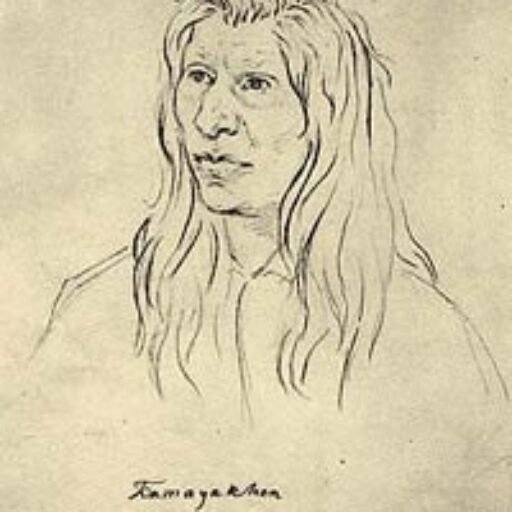
Kamiakin: the Last Hero of the Yakima
The Post-Treaty Wars (1855–1858)
Splawn frames the conflict as an inevitable collision caused by the “Treaty Period.” He emphasizes that while Kamiakin was a man of peace who initially sought to avoid war, the aggressive tactics of Governor Isaac Stevens and the encroachment of miners and settlers forced his hand.
The Outbreak (1855)
After the Walla Walla Council of 1855, the treaties were signed but not yet ratified. When gold was discovered in the Colville region, miners began trespassing through Yakama lands. Following the death of Indian Agent Andrew Bolon—who was killed while investigating the murder of miners—the U.S. Army moved to suppress the “insurrection.”
Key Figures & Actions
Splawn provides vivid, firsthand-style accounts of the major players:
Kamiakin (Yakama): Splawn portrays him as a “Napoleon of the Indians.” He was a brilliant diplomat who organized a massive confederation of tribes (Yakama, Palouse, Walla Walla, and Cayuse). Splawn highlights his strategic mind, noting he fought not for glory, but out of a tragic realization that his people were being erased.
Qualchan (Yakama/Palouse): Kamiakin’s nephew, whom Splawn depicts as a daring and fierce warrior. He and his father’s OW-hi eventual execution by Colonel Wright (without trial) is treated as one of the darker, more dishonorable moments of the campaign.
Colonel George Wright (U.S. Army): The commander of the 1858 campaign. Splawn details Wright’s “scorched earth” policy—the burning of food stores and the slaughter of 800 Palouse horses at Horse Slaughter Camp (near present-day Liberty Lake/Spokane)—as the tactical blow that finally broke the tribal resistance.
Major Granville Haller: Known for the “Haller Defeat” in 1855, where Kamiakin’s superior numbers and tactics forced a humiliating retreat for the U.S. troops, proving that the Plateau tribes were a formidable military force.
The Conclusion
The book concludes the war era with the Battle of Four Lakes and the Battle of Spokane Plains (1858). Splawn illustrates how the Army’s new long-range rifles and the destruction of the horse herds rendered traditional tribal warfare impossible, leading to Kamiakin’s flight to British Columbia and eventually the Bitterroot Valley.
About the Author: Jack Splawn (1844–1917)
Andrew Jackson “Jack” Splawn was more than a historian; he was a participant in the development of the Yakima Valley. Born in Missouri, he came west to the Oregon Territory as a boy. By the 1860s, he was a 15 year old “cow-boy” and cattle driver, moving herds through the very canyons where the wars had just ended.
Splawn’s life was deeply intertwined with the landscape of the Northwest. He established a trading post known as “Robber’s Roost” (the first store in what is now Ellensburg) and became a prominent livestock grower and local politician. Because he spent his life riding with both white pioneers and Indigenous elders, his writing contains details of geography and tribal lineage that “armchair” historians of his time often missed.
While his writing carries the biases of a 19th-century settler—often using the terminology of his era—he held a profound, late-life respect for Kamiakin. He saw the chief as a tragic hero rather than a “savage” enemy, and he wrote the book specifically to ensure that the “Indian side” of the story, as he had heard it from tribal leaders, would not be forgotten.
Jack Splawn’s Kamiakin: The Last Hero of the Yakamas (originally published in 1917) is a seminal—though distinctly frontier-flavored—account of the conflict in the Pacific Northwest. Splawn wasn’t an academic; he was a man who lived through the tail end of the era he described, making his book a mix of personal memoir and collected oral history.
Splawn’s book is considered a “primary-secondary” hybrid. It is one of the few places where the oral traditions of the Yakama and local settlers were captured before that generation passed away.
Significant Engagements of the Northwest Indian Wars
The Cayuse War (1847–1850)
The immediate aftermath of the Whitman Massacre.
November 29, 1847: The Whitman Massacre. Cayuse warriors attack the mission at Waiilatpu. This event serves as the primary justification for the subsequent military campaigns in the region.
January 8, 1848: Battle of Sand Hollow. The first major engagement of the Cayuse War. Oregon Volunteers clash with Cayuse and Palouse forces in the Oregon high desert. The volunteers successfully reach the mission site, but the war continues as a series of skirmishes.
The Yakima War & Puget Sound War (1855–1856)
Triggered by the unratified “Stevens Treaties” and the Colville gold rush.
October 6–8, 1855: Battle of Toppenish Creek (Haller’s Defeat). Major Granville Haller is intercepted by Kamiakin’s forces. The tactical defeat of the U.S. Army signals that the Plateau tribes are a sophisticated military power.
December 7–10, 1855: Battle of Walla Walla. A four-day battle between the Oregon Mounted Volunteers and a multi-tribal confederation. The death of Chief Peopeomoxmox during this battle remains one of the most controversial events of the era.
January 26, 1856: Battle of Seattle. Native forces attack the fledgling settlement. The defense is bolstered by the USS Decatur, marking a rare instance of naval artillery used in the Pacific Northwest Indian Wars.
March 26, 1856: Cascade Massacre. An attack on the vital portage at the Cascades of the Columbia. A young Lieutenant Philip Sheridan leads a counter-attack that stabilizes the supply line to the interior.
The Coeur d’Alene War / Spokane War (1858)
The campaign that fundamentally broke tribal resistance in the Inland Northwest.
May 17, 1858: The Steptoe Disaster (Battle of Pine Creek). Near Rosalia, WA, a force of over 1,000 Coeur d’Alene, Spokane, and Palouse warriors surrounds Colonel Steptoe. The troops barely escape a total massacre by retreating at night.
September 1, 1858: Battle of Four Lakes. Colonel George Wright returns with superior weaponry (Minie ball rifles). For the first time, the Army is able to strike tribal forces from a distance before they can get into range with their own weapons.
September 5, 1858: Battle of Spokane Plains. A final, exhausting running battle across the prairies west of Spokane. This engagement disperses the tribal confederation.
September 8–10, 1858: The Horse Slaughter (Liberty Lake). To ensure the tribes could not regroup, Wright orders the execution of 800 Palouse horses. This “economic warfare” destroys the tribes’ mobility and wealth, effectively ending the war in the Washington interior.
The Final Northwest Resistance (1876–1878)
The closing chapter of armed conflict.
June 17, 1877: Battle of White Bird Canyon. The opening of the Nez Perce War. Chief Joseph and his followers inflict a massive defeat on the U.S. Cavalry in the Idaho canyons.
October 5, 1877: Battle of Bear Paw Mountain. After a 1,100-mile fighting retreat, the Nez Perce are intercepted just 40 miles from the Canadian border. Chief Joseph delivers his famous surrender speech.
July 8, 1878: Battle of Birch Creek. The decisive engagement of the Bannock War. General James Forsyth defeats a combined force of Bannock and Shoshone warriors in eastern Oregon.
Historical Note:
Starting with 1847 highlights a specific transition: the move from Missionary influence to Military administration. It frames the “Indian Wars” as a continuous thirty-year struggle (1847–1878) rather than a series of disconnected skirmishes.